

WEEKLY E-MAIL

GEOPOLITICS AND THE SHARE MARKET
By Paul Nicol
It is fair to say that the current geopolitical environment is as uncertain as we have seen in a long while. The extraordinarily high levels of uncertainty and volatility are influencing the global economic outlook, trade and investment, inflation, financial markets, and commodity markets.
While geopolitical events quite rightly capture significant attention, they generally do not have a substantial impact on bond and equity markets. This is not to diminish the tragedy of conflict and its real impact on communities affected, but rather to highlight that, absent a larger, more protracted conflict that draws in Western powers, geopolitical turmoil tends to have limited effect on bond and equity markets.
To provide historical context around market behaviour, a look back at some key geopolitical events over the past 25 years, to observe what impact, if any, foreign conflicts had on bond and equities, helps to provide context.
The table below uses the US S&P 500 and US 10-year Treasury as indicators for shares and bonds.
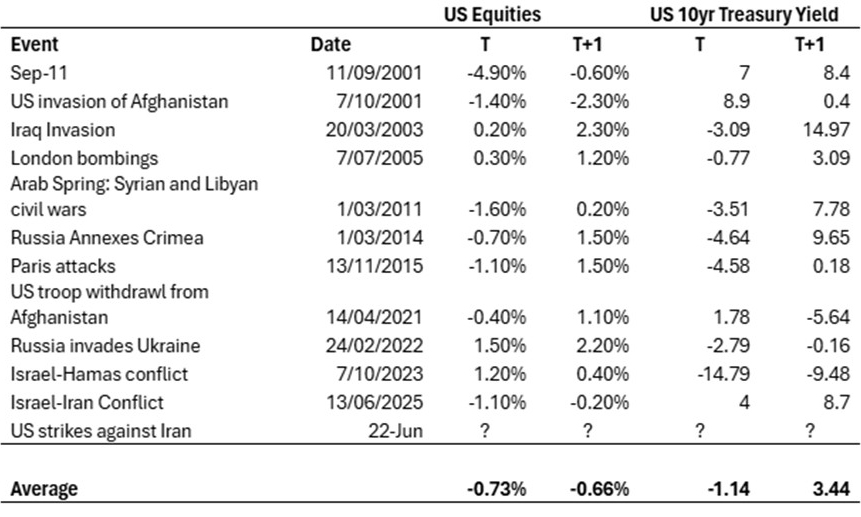
The list below is not comprehensive, and you can debate which events should make the cut. The bottom line is that the average move in bond yields and shares is relatively muted.
When do geopolitics really matter for markets? Absent a large-scale, multi-country conflict that draws in Western powers on such a scale that economies suffer materially (basically WWIII), the impact will likely be contained.
The key exception to this could be oil prices. Any significant and sustained surge in oil prices poses a clear headwind for growth and remains the primary risk that could shift the outlook. This risk could materialise if the critical Hormuz Strait, through which 20% of global oil passes, is threatened by Iran to the point of closure. However, we consider this as an outside risk given Iran’s dependence on oil exports, including to backers such as China.
When Russia invaded Ukraine in 2022, oil prices surged to $120 a barrel due to fears of sanctions and supply disruptions. However, oil prices did not remain elevated for long, and the lasting economic impact on global markets was muted.
In the upcoming period, we believe uncertainty will be a defining theme of the current global economic environment. It is important to remain vigilant of geopolitical tensions’ impacts on markets, but not to such an extent that it should change your long-term investment strategy.
Paul Nicol


Managing Partner
Senior Financial Planner
SMSF Specialist Advisor™
Barron’s Top Financial Adviser 2017-2024
Authorised Representative No. 230876
If you have any questions or comments, please email me at paul@gfmwealth.com.au
Disclaimer: This document is not an offer or invitation to any person to buy or sell any interest in or deposit funds with any institution. The information here is of a generic nature, and does not take into account your investment objectives or financial needs. No person should act upon this information without firstly seeking competent, professional advice specifically relating to their own particular situation.
Copyright: © This publication is copyright. Subject to the conditions prescribed under the Copyright Act, no part of it may, in any form, or by any means (electronic, mechanical, microcopying, photocopying, recording or otherwise) be reproduced or transmitted without permission. Enquiries should be addressed to GFM Wealth Advisory.

3 Mar 2026

23 Feb 2026
2 Feb 2026