

WEEKLY E-MAIL

THE STATE OF THE GLOBAL ECONOMY
By Denise Slattery
After growing by an estimated 2.90 per cent in 2019, the International Monetary Fund (IMF) recently announced its forecast for world economic growth of 3.3 per cent in 2020 and 3.4 per cent growth in 2021. In October, the IMF reported projected growth of 3.4 per cent in 2020 and 3.6 per cent in 2021.
The IMF advised that the downward revision primarily reflects negative surprises to economic activity in a few emerging market economies, notably India, which led to a reassessment of growth prospects over the next two years.
In a few cases, this reassessment also reflects the impact of increased social unrest. The IMF highlighted that downside risks to the global economy remain prominent, including rising geopolitical tensions, notably between the United States and Iran, intensifying social unrest, further worsening of relations between the United States and its trading partners, and deepening economic frictions between other countries. If any of these risks materialise, a rapid deterioration in sentiment could occur, causing global growth to fall.
The global growth path reflects a sharp decline, followed by a return closer to historical norms for a group of underperforming and stressed emerging market and developing economies (including Brazil, India, Mexico, Russia, and Turkey). The growth profile also relies on relatively healthy emerging market economies maintaining their strong performance, even as advanced economies and China continue to slow gradually toward their potential growth rates. The US is tipped to grow 2.0 per cent in 2020 after 2.3 per cent growth in 2019, and after 6.1 per cent growth in China in 2019, the Chinese economy is tipped to grow 6.0 per cent in 2020.
The effects of substantial monetary easing across advanced and emerging market economies in 2019 are expected to continue to have an impact on the global economy during 2020. The global growth estimate for 2019 and projection for 2020 would have been 0.5 percentage point lower in each year without this monetary stimulus.
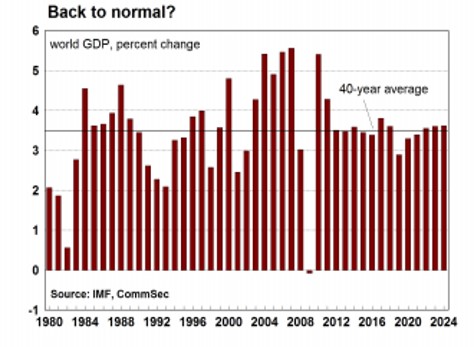
As highlighted in the chart below, it would appear that world economic growth is stabilising as the world’s GDP (Gross Domestic Product) levels move towards the 40 year average:
Denise Slattery
Senior Para-Planner
Authorised Representative No. 304356
If you have any questions or comments, please email me at denise@gfmwealth.com.au
Disclaimer: This document is not an offer or invitation to any person to buy or sell any interest in or deposit funds with any institution. The information here is of a generic nature, and does not take into account your investment objectives or financial needs. No person should act upon this information without firstly seeking competent, professional advice specifically relating to their own particular situation.
Copyright: © This publication is copyright. Subject to the conditions prescribed under the Copyright Act, no part of it may, in any form, or by any means (electronic, mechanical, microcopying, photocopying, recording or otherwise) be reproduced or transmitted without permission. Enquiries should be addressed to GFM Wealth Advisory.
13 Jul 2026
4 Jun 2026
27 May 2026