

WEEKLY E-MAIL

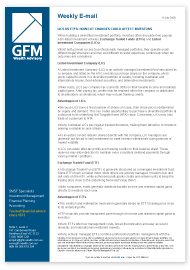
WHAT ARE THE CATALYSTS FOR FINANCIAL MARKETS IN FY2025?
By Sam Eley
Financial markets across most sectors have had a strong financial year 2024, leading to healthy performance across investment portfolios and superannuation fund balances.
While it’s always nice to see positive returns on equity markets, as we head into financial year 2025, it’s important to consider the current economic outlook and understand what the catalysts will be for positive (or negative) returns as we head into the ‘new year’.
The latest interest rate rising cycle from May 2022 was the most aggressive in 30 years, and the first interest rate rises since November 2010. This led to significant household pain, and asset classes with high levels of gearing, or interest rate sensitivity, such as Property, Bonds and Infrastructure, felt the brunt of negative returns from these rises. Corporate Australia managed this change largely very well, in turn becoming more conservative with gearing levels. At less than 1x Net Debt / Earnings Before Interest, Tax, Depreciation and Amortization (EBITDA), Australia’s largest companies appear well placed to handle any bumps in the economic cycle:

In addition, Australia continues to increase migration and employment. Compared to pre-COVID 19, an additional 1.35 million people are employed in the country, a 10% increase. These numbers compare favourably to other developed economies (e.g. the UK has increased by 1% over the same time period). This growth in labour force in turn translates to spending, with retail sales increasing 30% over the last five years and likely to be spurred on further by the combination of the Stage 3 tax cuts, as well as potentially interest rate cuts, throughout FY2025.

On the downside, risks to markets are mainly around persistent and sticky inflation. Markets have been buoyed by the progressive downward trend on inflation and holding of interest rates for the last several months. Markets are also anticipating the likelihood of interest rate cuts either later in 2024 or early 2025. Should inflation spike and the likelihood of rate rises increase, markets will in turn become more volatile and likely pull back.
On the geopolitical front, with US and French elections dominating headlines and wars in Europe and the Middle East continuing, there are reasons to be cautious as we head into next financial year.
The last few years of volatility continue to remind us of the importance of remaining diversified across asset classes, while building in safeguards within portfolios via a high degree of income yield and capital protection.
Sam Eley
Senior Financial Planner
Authorised Representative No. 1234685
If you have any questions or comments, please email me at sam@gfmwealth.com.au
Disclaimer: This document is not an offer or invitation to any person to buy or sell any interest in or deposit funds with any institution. The information here is of a generic nature, and does not take into account your investment objectives or financial needs. No person should act upon this information without firstly seeking competent, professional advice specifically relating to their own particular situation.
Copyright: © This publication is copyright. Subject to the conditions prescribed under the Copyright Act, no part of it may, in any form, or by any means (electronic, mechanical, microcopying, photocopying, recording or otherwise) be reproduced or transmitted without permission. Enquiries should be addressed to GFM Wealth Advisory.
13 Jul 2026
4 Jun 2026
27 May 2026