
WEEKLY E-MAIL

SLOWING WAGE GROWTH
By Karen Maher
The seasonally adjusted Wage Price Index (WPI) for the quarter ending 31 December 2022 was recently released by the Australian Bureau of Statistics.
The WPI is a price index that measures changes over time in wages and salaries for employee jobs unaffected by changes in the quality or quantity of work performed.
During the quarter, wage growth slowed from 1.1% for the three months to 30 September to 0.8%, slightly below the 1.0% forecast.
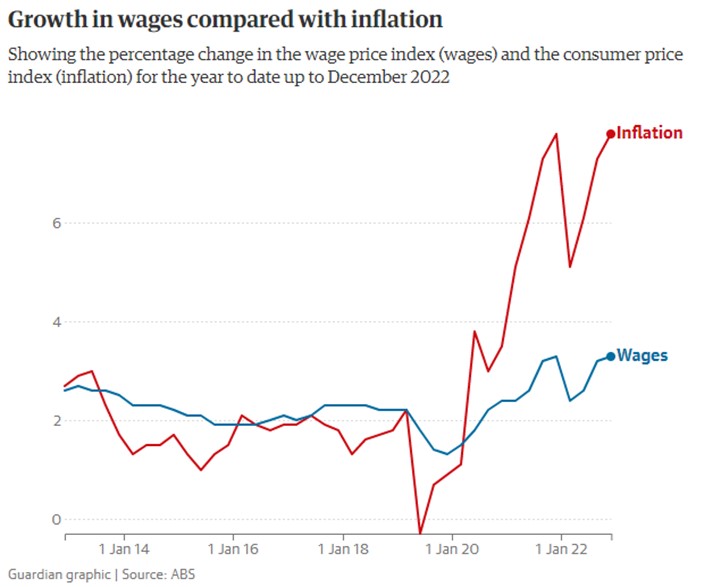
Over the 12 months, annual wage growth was 3.3%, an increase from the 3.1% figure at the end of the September quarter and the highest since the end of 2012.
Private sector wage growth over the quarter rose 0.8% (3.6% annualised), slightly higher than the public sector’s 0.7% (2.5% annualised).
The main driver of wage growth in 2022 was pay rises for workers on individual agreements, contributing to almost 60% per cent of the salary boost in the December quarter and through the year.
Around 21% of private sector workers received pay rises in December, above the pre-pandemic average. Workers who did receive a pay bump experienced an average wage increase of 4%, which was lower than the record 4.3% increase delivered in the September quarter.
Employers also increased the use of bonuses, with private sector wages, including one-off remuneration, increasing 3.8% over the year, just shy of a decade high.
An increase in hospitality, aviation and tourism wages provided a modest bump to the headline growth number, due to the deferral of award wage increases for these sectors from July to October.
Workers in the accommodation and food services industry received the largest pay rise in December, recording an average wage increase of 1.7%.
Despite the wage growth, high inflation means workers continue to go backwards in real terms. In the December quarter, consumer prices rose 7.8%, indicating real wages (adjusted for inflation) have declined by 4.5% over the last year.
The slowing wage growth over the quarter is not expected to deter the Reserve Bank of Australia (RBA) from further rate hikes over the next few months. Notes from the RBA’s February meeting revealed members agreed that further increases in interest rates are likely to be needed over the months ahead to ensure that inflation returns to target and the current period of high inflation is only temporary.
Karen Maher
Associate
If you have any questions or comments, please email me at karen@gfmwealth.com.au
Disclaimer: This document is not an offer or invitation to any person to buy or sell any interest in or deposit funds with any institution. The information here is of a generic nature, and does not take into account your investment objectives or financial needs. No person should act upon this information without firstly seeking competent, professional advice specifically relating to their own particular situation.
Copyright: © This publication is copyright. Subject to the conditions prescribed under the Copyright Act, no part of it may, in any form, or by any means (electronic, mechanical, microcopying, photocopying, recording or otherwise) be reproduced or transmitted without permission. Enquiries should be addressed to GFM Wealth Advisory.
13 Jul 2026
4 Jun 2026
27 May 2026