

WEEKLY E-MAIL

EUROPEAN ENERGY CRISIS
By Rebecca Dhillon
Here in Australia, many people are experiencing cost of living pains, with increasing electricity and gas bills likely to persist well into the new year. However, these challenges are relatively minor compared to what is occurring in Europe right now.
Following their invasion of the Ukraine, many Western countries imposed trade sanctions with Russia who, in response, cut the amount of oil and gas it sends to Europe which has resulted in soaring global prices.
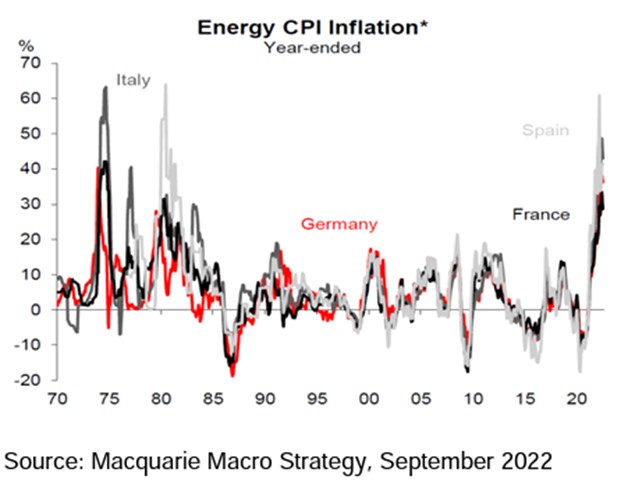
As Europe heads into their winter months, many European governments have introduced scheduled power outages to conserve resources, with Paris turning off the lights on the Eiffel Tower earlier, Amsterdam making swimming pools one degree colder and Milan turning off many of their public fountains.
This energy crisis is the biggest faced since the 1970s, when soaring oil prices helped create stagflation for which the decade is renowned. Today’s energy crisis is affected by three significant challenges that are set to persist in the short term:
1. Unfavourable Global politics
Russian oil and natural gas accounts for 40% of Europe’s energy needs, and Russian hydrocarbons equate to around 10% of global energy production. With gas supplies to Europe now being weaponised, oil and gas prices are likely to stay elevated in the short term.
2. Climate change
Recent droughts and heatwaves in China, Europe and North America continue to hinder hydropower electricity generation. In France, nuclear power reactors have been out of commission due to wildfires, with nuclear company EDF having to cut production because receding rivers makes it harder to cool reactors.
To date, not enough investment has been made in renewable energy sources, meaning it has not reached a level where it can compensate for the loss of Russia’s fossil fuels, hence the return to coal in Europe.
3. Policymaker Mistakes
Europe, and in particular Germany, have become overly reliant on Russian energy, importing almost 40% of its gas from Russia through the Nord Stream 1 pipeline. In June, Russian gas giant Gazprom cut volumes in Nord Stream 1 by 60%, with a further cut following in July, before being stopped indefinitely in September.
In France, 70% of its electricity is derived from 56 nuclear reactors, 30 of which are currently offline for routine maintenance that was not kept up during the pandemic. Furthermore, industrial action being undertaken could delay the timetable of getting rectors back online once maintenance has been completed.
As fears increase over energy insecurity, Germany, Italy, Austria and the Netherlands have indicated that they will allow coal-fired plants to reopen, or prolong operations beyond planned closure dates.
Over time, investments in renewable energy sources currently being undertaken will form a big part of how Europe escapes reliance on non-renewable fossil fuels in the future.
There is no doubt the disruption to French nuclear power, European hydropower and Russian gas, combined with higher oil prices are increasingly likely to trigger a recession in Europe. Policymakers have much to resolve before European gas and oil prices drop to anywhere near the pre-crisis averages, with better co-ordination across Europe needed. To date, there has been a varied response to high energy prices by governments. The European Central Bank is now in a difficult position as it will likely have to increase rates further, even as it becomes apparent that the Eurozone has entered a recession.
For investors, Australian and International shares are likely to continue to experience volatility in the short term, making it more important than ever to stick to your long term investment strategy.
Rebecca Dhillon
Senior Para-Planner
Authorised Representative No. 453075
If you have any questions or comments, please email me at rebecca@gfmwealth.com.au
Disclaimer: This document is not an offer or invitation to any person to buy or sell any interest in or deposit funds with any institution. The information here is of a generic nature, and does not take into account your investment objectives or financial needs. No person should act upon this information without firstly seeking competent, professional advice specifically relating to their own particular situation.
Copyright: © This publication is copyright. Subject to the conditions prescribed under the Copyright Act, no part of it may, in any form, or by any means (electronic, mechanical, microcopying, photocopying, recording or otherwise) be reproduced or transmitted without permission. Enquiries should be addressed to GFM Wealth Advisory.
13 Jul 2026
4 Jun 2026
27 May 2026