

WEEKLY E-MAIL

TWO EXTRA YEARS TO MAKE SUPERANNUATION CONTRIBUTIONS:
WORK TEST CHANGES ARE NOW LAW
By James Malliaros
In last year’s federal budget, the Australian Government announced a number of changes to the superannuation contribution rules to provide more flexibility for people to save for their retirement via superannuation. These changes included:
- Allowing those aged 65 and 66 to make voluntary contributions to superannuation without having to meet the work test (40 hours of gainful employment in a 30 consecutive day period)
- Increasing the cut-off age for spouse contributions from 70 years to 75 years
Legislation allowing people aged 65 and 66 to make voluntary super contributions without needing to satisfy a work test takes effect on 1 July 2020. This includes non-concessional contributions, personal concessional contributions and spouse contributions. As a result, people under age 67 have up to two extra years from the start of the 2020-21 financial year to make additional voluntary contributions even if they have retired from the workforce.
However, the proposal to increase the maximum age at which a person can trigger the non-concessional contributions cap ‘bring forward rule’ from 64 to 66 is currently before Parliament and has not yet been legislated. As Parliament is not scheduled to sit again until 4 August, it is very unlikely that this change will become law by its 1 July 2020 start date.
Non-concessional contributions
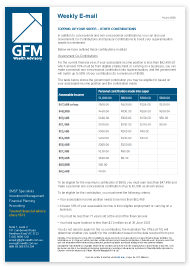
From 1 July 2020, people under age 67 can make non-concessional contributions without meeting the work test. This means that members age 65 and 66 at the time of the contribution, can contribute $100,000 per financial year, as long as they:
- Have a total superannuation balance just prior to the start of the financial year of less than $1.6 million, and
- Are not in the middle of an existing bring-forward period in the financial year.
As the proposal to increase the maximum age to trigger the bring-forward rule is still before parliament, at this stage those aged 65 or 66 are not able to trigger the bring-forward rule from 1 July 2020. However, it is expected that the proposed legislation will be passed when parliament resumes, allowing the bring-forward rule to be triggered for those who reach age 67 and allowing them to make non-concessional contributions of up to $300,000.
Maximising personal concessional contributions
The new work test rules allow people to make personal concessional contributions up until their 67th birthday, even where they have retired. This could assist them to maximise their retirement savings as well as manage their personal tax position by claiming a deduction for some or all of the value of the contribution in their tax return.
For example, a 66 year old retiree who sold an asset such as a residential investment property and realised an assessable capital gain, could offset some or all of any capital gains tax liability by contributing part of the proceeds to superannuation as a personal concessional contribution.
Spouse contribution rules
New rules also apply to spouse contributions from 1 July 2020. Under the new rules you are able to make spouse contributions where the receiving spouse is up to age 74 – this was previously limited to age 69. A spouse tax offset of up to $540 applies where the receiving spouse’s assessable income is below $40,000, with the maximum offset payable where income is below $37,000 and a spouse contribution of at least $3,000 is made.
James Malliaros
Senior Financial Planner
Certified Financial Planner®
SMSF Specialist Advisor™
Authorised Representative No. 291633
If you have any questions or comments, please email me at james@gfmwealth.com.au
Disclaimer: This document is not an offer or invitation to any person to buy or sell any interest in or deposit funds with any institution. The information here is of a generic nature, and does not take into account your investment objectives or financial needs. No person should act upon this information without firstly seeking competent, professional advice specifically relating to their own particular situation.
Copyright: © This publication is copyright. Subject to the conditions prescribed under the Copyright Act, no part of it may, in any form, or by any means (electronic, mechanical, microcopying, photocopying, recording or otherwise) be reproduced or transmitted without permission. Enquiries should be addressed to GFM Wealth Advisory.
13 Jul 2026
4 Jun 2026
27 May 2026