

WEEKLY E-MAIL

US INFLATION INCREASES LIKELIHOOD OF MORE LARGE RATE HIKES
By James Malliaros
This week’s meeting of the US Central Bank (Federal Reserve) is expected to deliver another supersized interest rate hike following the reacceleration in underlying inflation (CPI). Just as US share-markets had started pricing in less aggressive interest rate increases, data published early last week revealed growth in core CPI of 0.6 per cent, instead of an expected 0.3 per cent, which took its annual rate from 5.9 per cent in July to 6.3 per cent in August.
United States Core Inflation Rate
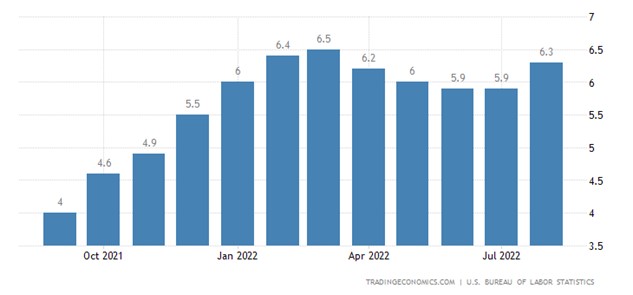
And while the headline CPI fell back to 8.3 per cent from 8.6 per cent, this compared to an expected drop to 8.1 per cent.
What is most disconcerting in the CPI numbers is that the strength in core inflation is very much service-led, including categories like vehicle repairs, dental and hospital services and food, which all posted significant gains. In addition, US wage growth is spreading inflation wider into services. Services inflation is now the battleground for the US Federal Reserve, with the supply of labour normalising far slower than goods supply.
With US inflation showing strong resilience, financial markets expect the Federal Reserve to raise interest rates by 75 basis points (0.75%) for the third consecutive time at its meeting later this week, but it may hike by as much as 100 basis points (1.00%) in an attempt to clamp down even harder on inflation. The unexpectedly high August CPI report could lead the Federal Reserve to continue its aggressive hikes longer than many investors had anticipated.
With interest rates rising so steeply, equity markets remain vulnerable to further sell-offs, as we have experienced since the start of the 2022 calendar year, particularly over the last few months, with the ASX 200 posting its biggest single day loss over the last two years last Wednesday.
As always, Australian interest rates will follow the US, but the Reserve Bank of Australia (RBA) seems prepared to show a bit more patience than the US Federal Reserve. This is due to a number of factors, but the two main ones are wages and our floating rate mortgage market.
A recent NAB business survey showed that rate hikes are yet to have any impact on consumers, which is not surprising as the economy is now almost fully open and many consumers have pent-up savings to spend. In addition, fixed rates are protecting 40 per cent of mortgage holders from higher interest rates… for the moment at least.
As such, the RBA will likely rely on the upcoming fixed rate mortgage cliff and immigration to do the heavy lifting to combat inflation in 2023.
The Australian share market is therefore expected to continue outperforming the US share market for the remainder of the year, given that local interest rates are likely to remain well below that in the US as inflation isn’t quite as high.
However, the only certainty for now is volatility is here for a while yet.
James Malliaros
Senior Financial Planner
Certified Financial Planner®
SMSF Specialist Advisor™
Authorised Representative No. 291633
If you have any questions or comments, please email me at james@gfmwealth.com.au
Disclaimer: This document is not an offer or invitation to any person to buy or sell any interest in or deposit funds with any institution. The information here is of a generic nature, and does not take into account your investment objectives or financial needs. No person should act upon this information without firstly seeking competent, professional advice specifically relating to their own particular situation.
Copyright: © This publication is copyright. Subject to the conditions prescribed under the Copyright Act, no part of it may, in any form, or by any means (electronic, mechanical, microcopying, photocopying, recording or otherwise) be reproduced or transmitted without permission. Enquiries should be addressed to GFM Wealth Advisory.
13 Jul 2026
4 Jun 2026
27 May 2026