

WEEKLY E-MAIL

EMPLOYMENT A KEY TO ECONOMIC RECOVERY
By Rebecca Lowe
With Melbourne now in lockdown for the second time and an increasing wave of diagnosed COVID–19 cases, many people are questioning how this ‘second wave’ may impact Australia’s economic recovery. With Victoria representing Australia’s second-largest state economy, increased restrictions and lockdown measures make the national economy more vulnerable. It will likely see Australia’s economic recovery take longer and occur more slowly than initially forecast.
With this health crisis far from over, state, territory and the Federal Government are all focused on getting the economy moving again, with our path to recovery heavily dependent on employment growth.
Recently released Labour force data from the Australian Bureau of Statistics (ABS) for June, shows that the national unemployment rate increased from 7.1% in May to 7.4% in June – the highest rate it’s been since 1998. However, the real picture of unemployment is much worse, with Treasurer Josh Frydenberg admitting that unemployment is closer to 13.3%, suppressed by the Government’s employment stimulus measures.
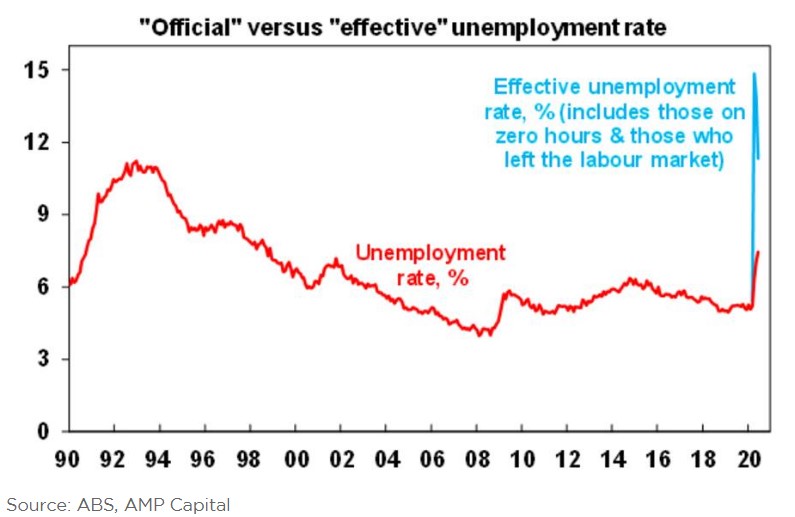
Full–time employment decreased by 38,100 people and part-time employment increased by 249,000 people, primarily due to the relaxing of restrictions in the hospitality sector. But while 210,800 jobs were created in June, 871,500 were lost in April and May indicating there is a long way to go before we return to pre–COVID employment levels.
The Australian job market continues to remain underwritten by the Federal Government’s employment assistance programs such as JobKeeper, which is scheduled to cease in September.
With heightened concerns around employment as Victoria enters our second phase of lockdown, later this week the Treasurer will provide a midway review of the JobKeeper program, as well as the first detailed economic and fiscal update since the COVID–19 outbreak. Concerning the JobKeeper payment, the Treasurer has already hinted that the flat payment could face significant changes to reflect real wages. There is speculation that the amount paid will be reduced, eligibility criteria will be tightened, and the program will be extended through until December.
Employment will be a crucial driver of economic recovery, as being rewarded for labour underpins household income, the driving force behind consumption. It also provides the Australian Government with its primary source of revenue – individual income tax – which made up 45% of estimated revenue in the 2019–20 Federal Budget. As the number of people losing their jobs continues to increase, consumption of goods and services will remain subdued and economic activity in Australia will remain weak.
Rebecca Lowe
Senior Para-Planner
Authorised Representative No. 453075
If you have any questions or comments, please email me at rebecca@gfmwealth.com.au
Disclaimer: This document is not an offer or invitation to any person to buy or sell any interest in or deposit funds with any institution. The information here is of a generic nature, and does not take into account your investment objectives or financial needs. No person should act upon this information without firstly seeking competent, professional advice specifically relating to their own particular situation.
Copyright: © This publication is copyright. Subject to the conditions prescribed under the Copyright Act, no part of it may, in any form, or by any means (electronic, mechanical, microcopying, photocopying, recording or otherwise) be reproduced or transmitted without permission. Enquiries should be addressed to GFM Wealth Advisory.
13 Jul 2026
4 Jun 2026
27 May 2026