

WEEKLY E-MAIL

US PRESIDENTIAL ELECTION – ASSESSING THE STOCK MARKET IMPLICATIONS
By James Malliaros
With only days left to run in the US presidential election campaign, the candidates are offering two strikingly different visions on the issue US voters say matters most to them: the economy. Vice President Kamala Harris and former President Donald Trump have radically different views on how to manage the U.S. economy.
The polls are incredibly close at the moment and the winner still remains far from certain. June’s disastrous debate performance from Joe Biden resulted in his win probability dropping down to 10%, then two weeks later after Trump survived an assassination attempt, Trump’s odds skyrocketed to a record high of 70%.
When the Democratic party then made the decision to replace Biden, the race has been neck-and-neck, with Harris gaining a small edge following her impressive debate performance in mid-September.
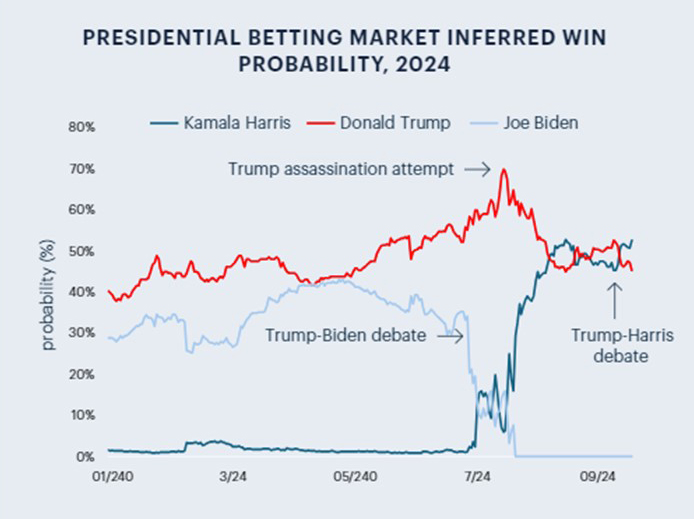
Whilst these twists and turns make may result in ongoing market volatility, they rarely predict the longer-term direction of financial markets. No matter who wins the presidential election on November 5th, the result should be a positive one for the US stock market.
Harris, if elected, wants to further support programs that boost innovative industries including AI, electric vehicles and green energy, along with social programs to level up the struggling working and middle classes. Hers is an embrace of capitalism with “free and fair markets.”
In a nutshell, Harris wants to double down on President Joe Biden’s industrial policies by adding another $100 billion in investments in AI, semiconductors, solar, hydro, batteries and materials critical to U.S. national security, while also lifting established industrial communities that have been disrupted, as well as underrepresented groups.
Harris also intends to offer more help to working families with greater federal support for childcare, enlarged child tax credits and expanded apprenticeship programs for people who aren’t planning to attend college.
A Harris administration would pay for this by letting the benefits of the Tax Cut and Jobs Act of 2017 lapse for those earning more than $400,000; imposing a minimum corporate tax of 15% to align the U.S. with an international treaty mandating a floor under business taxes; and raising the nominal corporate tax rate to 28% from 21%.
Trump, meanwhile, promises to lower the U.S. corporate tax rate to 20%, and 15% for domestic manufacturers, which would make creating jobs in America more attractive. Trump would pay for this with import tariffs — 10% to 20% across the board and 60% on Chinese-made goods, which could prove to be quite disruptive to financial markets. Trump also proposes an array of personal tax breaks such as for overtime pay, tips and Social Security payments.
Unfortunately, neither candidate has proposed enough new revenue to fund their respective proposals, though Trump likely would bloat the federal deficit by more than $US4 trillion over the next 10 years compared to Harris. Also, Harris and Trump both would confront unfair competition from China, though more so with Trump.
For investors, betting on the outcome of an election, particularly on ‘The Trump Trade’ should he win, is risky business, especially given how close the contest is.
Suffice it to say, if Harris becomes president, then EV manufacturers, EV charging network operators and solar stocks, as well as their suppliers, would all get a boost. If Trump prevails, then legacy automakers still reliant on internal combustion engines would benefit, as would oil and gas stocks.
As for the broad U.S. stock market, it will most likely prosper but not without some degree of volatility. With all the expected investment and fiscal stimulus, efforts to reduce inflation may stall, and US Treasury yields could increase, but real growth and profits should be robust no matter who wins.
Given the uncertainties ahead, we continue to emphasise the importance of a diversified portfolio approach in the current environment to mitigate risks. Maintaining a well-diversified portfolio with a healthy cash and fixed interest exposure will also assist to limit the downside risks in inevitable periods of share market volatility.
James Malliaros
Senior Financial Planner
Certified Financial Planner®
SMSF Specialist Advisor™
Authorised Representative No. 291633
If you have any questions or comments, please email me at james@gfmwealth.com.au
Disclaimer: This document is not an offer or invitation to any person to buy or sell any interest in or deposit funds with any institution. The information here is of a generic nature, and does not take into account your investment objectives or financial needs. No person should act upon this information without firstly seeking competent, professional advice specifically relating to their own particular situation.
Copyright: © This publication is copyright. Subject to the conditions prescribed under the Copyright Act, no part of it may, in any form, or by any means (electronic, mechanical, microcopying, photocopying, recording or otherwise) be reproduced or transmitted without permission. Enquiries should be addressed to GFM Wealth Advisory.
13 Jul 2026
4 Jun 2026
27 May 2026