

WEEKLY E-MAIL

A WRAP UP OF REPORTING SEASON
By Rebecca Dhillon
The ASX earnings reporting season wound up at the end of February, a time when major Australian companies provide updates on their financial position, not just what has happened but also outlining what they perceive to lie ahead.
CommSec economists have assessed the results of 137 ASX 200 companies that reported half-year earnings to December, and the 27 companies reporting full year results for 2022. However, analysis is conducted on the half year results and aggregated to obtain a ‘big picture’ view of reporting season. The results are summarised as follows:
- 87% of companies reported a profit
- 30% reported a fall in profits, as expenses outpaced income
- 15% reported a rise in expenses
- 11% reported an improvement in sales
- Over 88% of companies issued a dividend, with dividends rising 5% (aggregated)
- Over 53% of companies lifted dividends, 22% cut dividends and 12% left dividends unchanged
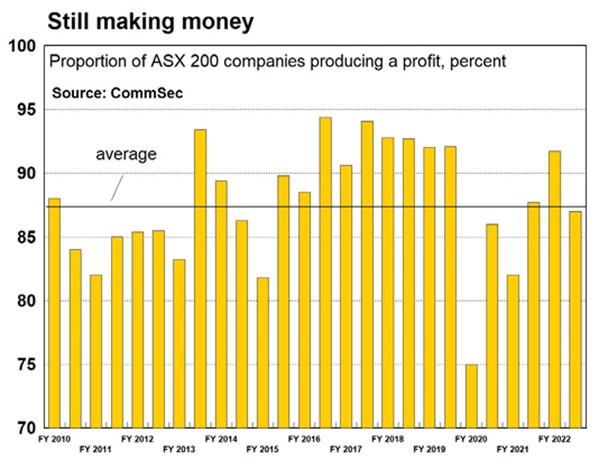
Despite higher inflation and a tight labour market, earnings upgrades and downgrades were broadly in line with historical averages. However rising interest rates, lingering supply chain issues and energy prices are at different stages of working their way through corporate Australia.
Some of the key themes to emerge from reporting season are:
Interest rates
While the effect of increasing interest rates is largely understood, there is a lag as companies adjust their decision making to reflect higher costs. And with some companies locked in to fixed interest rates, the impact of rising rates has not fully flowed through to profit and loss statements.
Labour cost pressures
Labour costs are rising amid persistent labour shortages, but the full effect could take some time to flow though, resulting in labour pressures persisting for some companies in the short term.
Inflation
Businesses are finding it challenging to pass on higher costs to consumers, weighing on earnings. But while profit margins have come under pressure on the back of rising operating costs, many companies reported that cost pressures may have peaked.
Consumer confidence
Consumer discretionary spending has eased under the weight of interest rate hikes and cost of living pressures, with retailers highlighting the change in consumer behaviour. Consumers are buying more home brands at supermarkets and generally being more cost conscious, they are spending more time at home over going out and may take on more DIY projects.
While there have been a number of negative influences on Australian companies over the last six months, the results generally paint a picture of a more robust than expected economy. While the next six months are likely to be as equally challenging as the previous with more rate hikes ahead, the economy is tipped to slow quickly so that rate cuts may be delivered late in 2023 or early 2024.
Rebecca Dhillon
Senior Para-Planner
Authorised Representative No. 453075
If you have any questions or comments, please email me at rebecca@gfmwealth.com.au
Disclaimer: This document is not an offer or invitation to any person to buy or sell any interest in or deposit funds with any institution. The information here is of a generic nature, and does not take into account your investment objectives or financial needs. No person should act upon this information without firstly seeking competent, professional advice specifically relating to their own particular situation.
Copyright: © This publication is copyright. Subject to the conditions prescribed under the Copyright Act, no part of it may, in any form, or by any means (electronic, mechanical, microcopying, photocopying, recording or otherwise) be reproduced or transmitted without permission. Enquiries should be addressed to GFM Wealth Advisory.
13 Jul 2026
4 Jun 2026
27 May 2026