

WEEKLY E-MAIL

INTEREST RATE PAUSE UNLIKELY AS WAGE INFLATION SURPRISES ON THE UPSIDE
By James Malliaros
The latest Wage Price Index (WPI) for the September quarter came in stronger than expected, reaching a decade high 1.0% increase over the quarter. Over the last 12 months the WPI has risen 3.1%, up from 2.6% in the June quarter.
The WPI is the official measure of wages growth in Australia. It measures changes in the price of labour in the Australian labour market. In a similar manner to the Consumer Price Index (a measure of inflation), the WPI follows price changes in a fixed “basket” of jobs and is therefore not affected by changes in quality and quantity of work.
Annual wage growth over the last 12 months
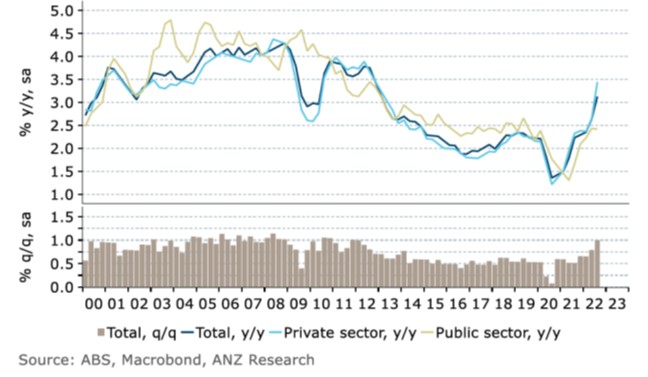
The strong results for the September quarter reflected the larger increase to minimum and award wages, which had flow-on effects to some enterprise bargaining agreements (EBAs) and individual arrangements. Affected sectors, like retail trade and administrative services, were strong.
The data also showed that Private sector wages rose 1.2% for the quarter, compared to only 0.6% for the public sector. Over the past year, private sector employees have seen an average wage increase of 3.4%, while public sector workers have seen their base pay rise by only 2.4%.
Significant labour market pressures in the private sector has resulted in large increases in the average size of hourly wage rises and an increase in the share of workers receiving a wage increase. This partly reflects the fact that some wage changes were deferred last year because of the pandemic.
Difficulty finding labour vs wage growth
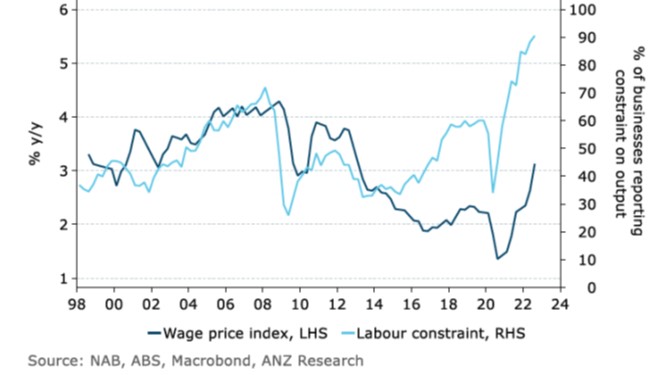
While the magnitude of the latest quarterly increase is unlikely to be repeated, minimum wage rises for the hospitality sector, which were originally delayed, will come through in the December quarter of this year. In addition, the September quarter data does not reflect the 15% pay rise for aged care workers – that decision was made in the current quarter, and the timing of the increase is still being confirmed.
Despite wages growth finally starting to take off, real Australian wages are contracting at a record rate, with the 3.1% increase in the WPI less than half the pace of headline inflation of 7.3%, with public sector workers being left further behind. In fact, the lowest pay increases were seen in the education and training sector, at 0.8% for the quarter and only 2.2% for the year. As a result, teachers across several jurisdictions and academics at many universities are currently engaged in industrial action to seek larger pay increases.
The strong WPI data is unlikely to surprise the Reserve Bank of Australia (RBA), as it had been signalling for some time businesses that it has been surveying were reporting significantly higher pay increases. However, wage gains in Australia remain relatively subdued, and are not at levels that would see the RBA fret about a wage-price spiral developing.
But wages are rising and therefore rather than the anticipated pause in hiking, a further 0.25% increase in interest rates in December is almost certain – this will then take the cash rate to just above 3% and continue the aim of curbing inflation.
James Malliaros
Senior Financial Planner
Certified Financial Planner®
SMSF Specialist Advisor™
Authorised Representative No. 291633
If you have any questions or comments, please email me at james@gfmwealth.com.au
Disclaimer: This document is not an offer or invitation to any person to buy or sell any interest in or deposit funds with any institution. The information here is of a generic nature, and does not take into account your investment objectives or financial needs. No person should act upon this information without firstly seeking competent, professional advice specifically relating to their own particular situation.
Copyright: © This publication is copyright. Subject to the conditions prescribed under the Copyright Act, no part of it may, in any form, or by any means (electronic, mechanical, microcopying, photocopying, recording or otherwise) be reproduced or transmitted without permission. Enquiries should be addressed to GFM Wealth Advisory.
13 Jul 2026
4 Jun 2026
27 May 2026